
Finding People Through Albany Records
A useful Albany people search follows the fact at hand. A name can enter the Dougherty County Clerk's free real-estate index or court party search. An address belongs first in the county parcel system, then in a deed index or an old reverse street guide. A family death may lead to an obituary, estate file, or death certificate. Each source describes a different role. A deed names parties to a land transfer, a parcel roll identifies the tax record, and a city directory may list an occupant who did not own the home.
Start broad, then verify with a second record. Try spelling variants, initials, a middle name, and a narrow date range. When a portal has no result, ask for an existing index page, docket sheet, register entry, or named file. Georgia agencies need not create a custom report from scattered facts.
- Search Dougherty REsearch by name and test alternate spellings.
- Check CM Web for the name as a party in a local case.
- Use qPublic when a street address or parcel is known.
- Move to probate, newspapers, or directories for older trails.
- Request a known record when no public index exists.
Albany People Search Record Desks
Three Pine Avenue offices hold much of the Albany record trail. The Clerk of Superior Court keeps deeds, liens, plats, and Superior and State Court files. The Board of Assessors maintains ownership and mapping records. Probate Court handles estates, wills, Dougherty marriage certificates, and Georgia birth and death certificates. City minutes, permits, police records, and Municipal Court requests run through Albany departments and JustFOIA. Detailed access rules belong with the Albany public records system.
Dougherty Clerk of Superior Court
225 Pine Avenue, Suite 126
Albany, GA 31701
229-431-2198
Search Albany's Free Deed Index
The Dougherty REsearch portal offers free index data and document images for deeds, liens, and plats. Six verified modes are Name, Book/Page, Land Description, Instrument Type, Cross-Reference, and Image. A free account is needed only for property-fraud notices. Try spelling variations, initials, and suffixes because an Albany name may appear in more than one form.
| Search mode | Starting fact | Use |
|---|---|---|
| Name | Grantor or grantee | Find transfer parties |
| Book/Page | Recorded citation | Open a known filing |
| Land Description | Legal land text | Follow land across owners |
| Instrument Type | Record class | Narrow broad results |
| Cross-Reference | Related filing | Trace linked records |
| Image | Image reference | Review the document |
The online start year is not published. FamilySearch identifies Dougherty deeds from 1854 and indexes from 1856. A grantor transfers an interest; a grantee receives it. An index points to a filing, while the image shows the recorded document.
The official source view shows the Albany name-search route.
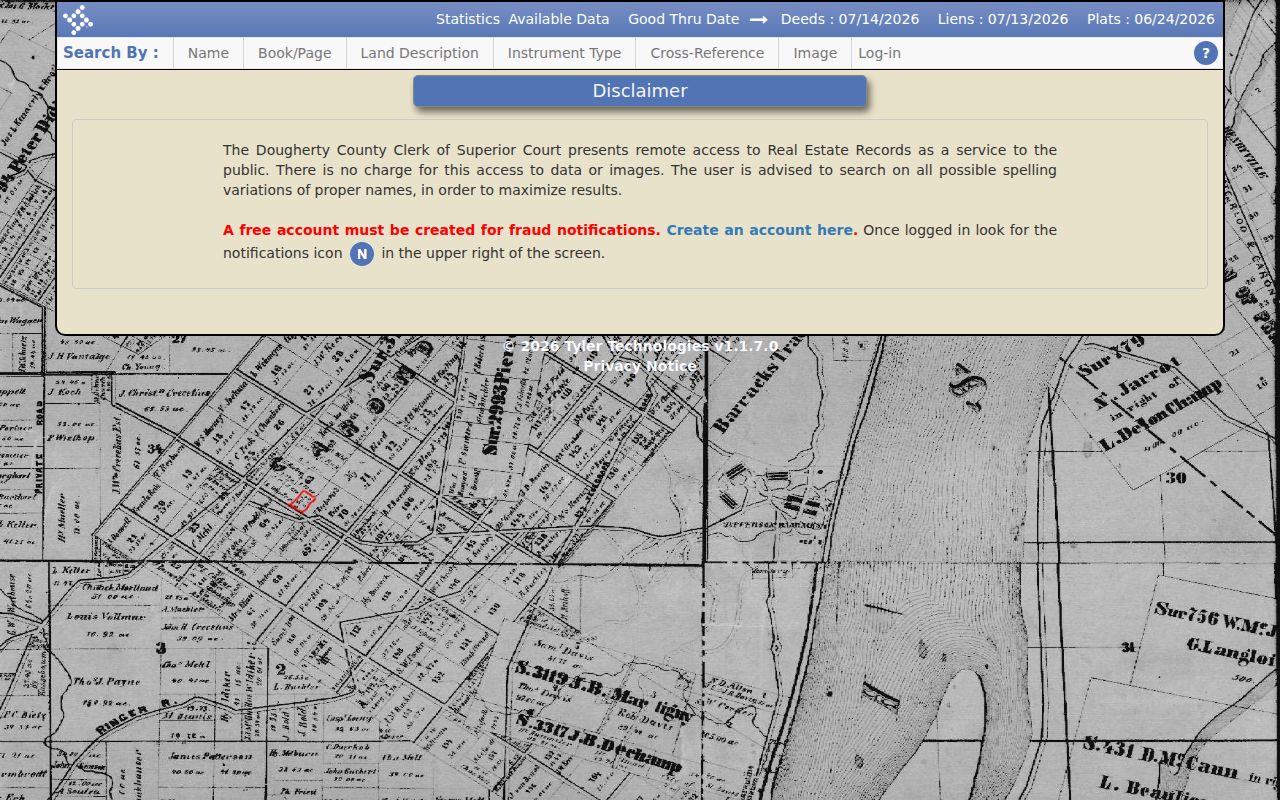
Names, land descriptions, and linked instruments can confirm the same person from separate facts.
Turn Albany Addresses Into Names
The county-linked Dougherty qPublic parcel search is the official start for a present address. Its dynamic controls and displayed fields were not verified, so no specific owner-name or sale-history feature should be assumed. If it fails, contact the Board of Assessors at 240 Pine Avenue, Suite 100, or call 229-431-2130.
A situs address is the physical location. An owner mailing address is where tax mail goes. A deed's legal description identifies the land and may not look like a street address. For an older Albany address, reverse street guides can name an occupant. That person can then be checked in deeds, probate, and newspapers.
The assessor and deed clerk answer different questions. The assessor keeps the current appraisal and map record for real estate, while the clerk preserves recorded transfers and liens. Tax Collections handles payment records for county, city, school-board, and state ad valorem taxes. Business personal-property questions use a separate assessor number, 229-431-2157. When the web map does not expose enough detail, ask the office for the existing parcel record rather than asking staff to identify a person from scratch.
Note: An occupant, taxpayer, and recorded owner may be three different people.
Albany Court Records by Name
The free Dougherty CM Web search covers Superior and State Court civil and criminal records. Party controls include last, first, and middle name; party type; court; division; filing dates; case status; and case number. A docket is a court's event list, not proof that every claim was true. Compare the role, dates, division, and case number before tying a result to one person.
Magistrate Court has separate civil and warrant work. Probate Court keeps estates and guardianships. Albany Municipal Court handles city ordinance and traffic matters but has no verified public name index. Requests go through JustFOIA or its counter. Sealed cases, juvenile material, and other protected records stay restricted; the clerk is the fallback for a known case absent online.
| Court | Covers | Name Search | Access |
|---|---|---|---|
| Superior and State | Felony, civil, misdemeanor | CM Web | Free online; clerk fallback |
| Probate | Estates and guardianships | Georgia Probate Records | Online; digitization request |
| Albany Municipal | Ordinance and traffic | No verified name index | Counter or JustFOIA |
Albany Vital Records and Kin
Dougherty Probate Court issues Georgia birth and death certificates and marriage certificates when the license began in Dougherty County. Birth access requires a direct and tangible interest under O.C.G.A. §31-10-26. Death plain copies may be issued with the Social Security number redacted. Local birth or death copies cost $25 for the first and $5 for each added copy ordered at once. Dougherty marriage certificates cost $10 plus $5 for an added copy.
The Georgia Department of Public Health holds statewide births and deaths from January 1919 forward and marriages from June 1952 through August 1996. Divorce records belong with the Superior Court clerk. For earlier family research, check the event county and Georgia Archives sources rather than assuming every old certificate is online.
Local Probate Court requests require an original hard-copy photo ID for birth and death certificates. Mail requests use a USPS money order, while the counter accepts cash, money order, or card with a vendor fee. A mailed Dougherty marriage-certificate request needs the court form, payment, and a self-addressed stamped envelope or shipping label. These direct channels remain important because vital certificates are not an unrestricted name-search database.
Dougherty Probate Files Find Heirs
Estate files can connect a deceased Albany resident with heirs, an administrator, land, and later transfers. Search Georgia Probate Records for pending and historical Dougherty cases. If a historical file is missing, Probate Court says staff can digitize it and place it online within one to two business days after a phone or email request. That direct fallback is unusually useful.
Ask for the specific estate file or register entry. Include the decedent's full name and an estimated death year. A decedent is the person who died. Compare estate names with an obituary and any deed transfer. This can distinguish an heir from a later buyer or another person with the same surname.
The probate portal pictured here is the official online access point.
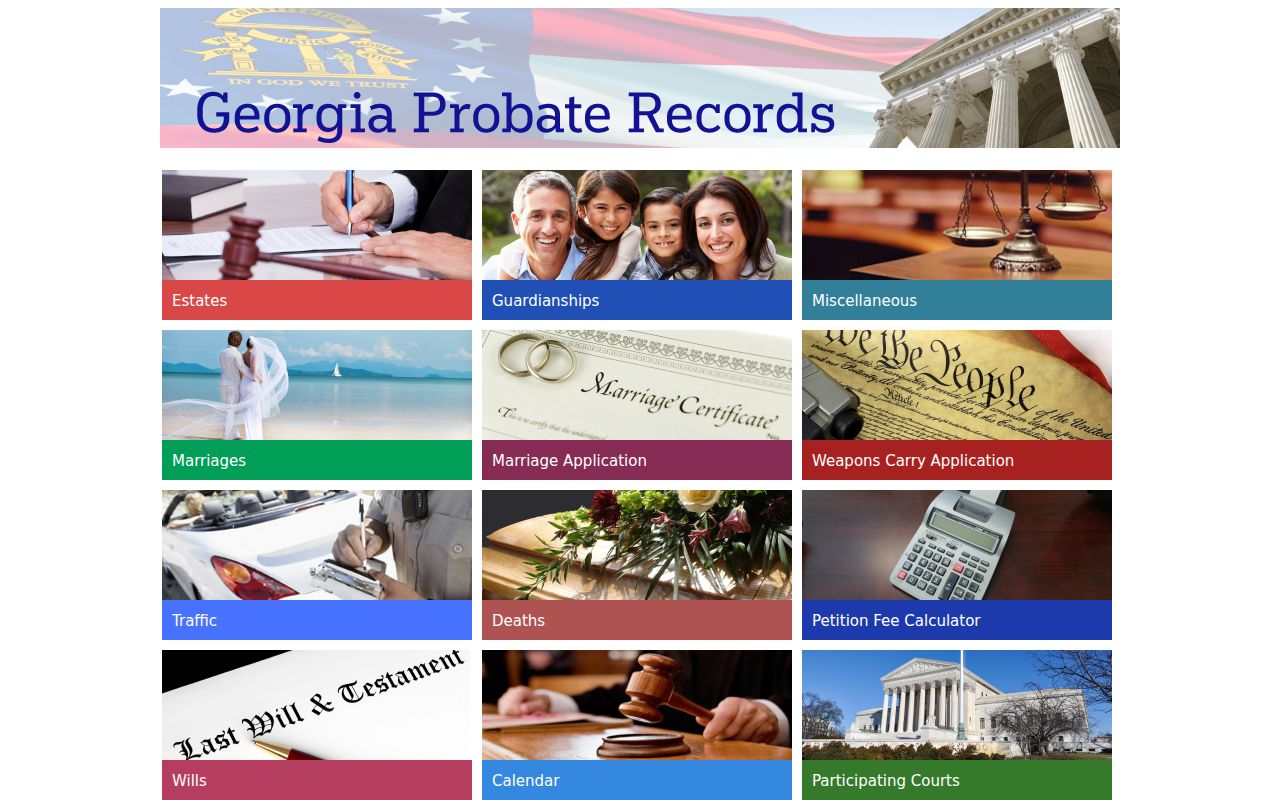
A missing scan is not always a dead end because Dougherty accepts direct digitization requests.
Albany Directories Bridge Old Streets
The Digital Library of Georgia Albany collection contains directory editions spanning 1907 through 1964. The 1907 item is a business and professional directory, not a full resident roll. Comprehensive resident, street, and civic listings begin in 1922 and continue at intervals. Many later volumes include numerical telephone and reverse street guides, which turn a house number into an occupant name.
The 1939 edition adds outside-city and car-owner markers and names a mill village and early suburbs. Later volumes include Darr Homes, Radium Springs, and Turner City. Search nearby headings when a street fails. OCR, machine-read text taken from scans, can misread names, so verify a hit against the image. The Albany people directories resource covers each directory in depth.
Albany Newspapers Restore Missing Links
The free Dougherty County Historic Newspapers collection covers ten title runs. It includes 1,000 issues of the Albany Patriot, plus the Albany News, Albany Tri-Weekly News, Daily News and Advertiser, and other local papers. The title set reaches from 1845 to 2000, though no one paper spans that whole period.
Obituaries can name relatives and places. Marriage notices connect surnames, while legal notices point toward probate or land files. Search initials, nicknames, and close dates. Albany's shift from river and rail work into farm processing, military support, and manufacturing also makes an occupation or employer useful for separating names.
Paper choice matters. A notice may appear under a legal name while a social item uses a nickname. Browse the issue around a known event when OCR returns nothing, and check the next edition for a correction. The archive preserves page images as well as searchable text, so names beside photographs, advertisements, and column headings may still be found by reading the scan. A probate date, directory address, or deed book reference can then test whether the newspaper person is the right Albany resident.
Note: Newspaper text is a lead; confirm key facts in the scan and official record.
Albany State Names Across Generations
Albany State University's digitized yearbooks provide a path for reconnecting with a classmate or tracing family history. Pendergrast Library and the Digital Library of Georgia make 73 items available, with visible holdings from 1949 forward. Pages connect names with faces, classes, faculty, clubs, and campus groups. They are especially significant for Albany's African American community history.
Try a surname, then inspect class and organization pages near a confirmed hit. A yearbook may supply a middle initial or club that separates two similar names. Carry that fact into a newspaper, directory, or deed search, but do not treat a school image as proof of a current identity or address.
Verify Albany Business and License Names
Georgia's official tools can confirm a public business role. The Corporations Division search accepts Business Name, Control Number, Registered Agent Name, Officer Name, or Designated Agent Name. Match choices include Starts With, Contains, and Exact Match. A registered agent receives legal papers; that role does not by itself prove ownership.
Professional license verification uses optional profession, license type, license number, first or middle name, and last name fields. The state advises using fewer fields and permits an asterisk after a partial term. Results may show license status, dates, related licenses, and public board orders. Compare the profession and license number, not just the name.
The official license screen shows how an Albany name can be narrowed.
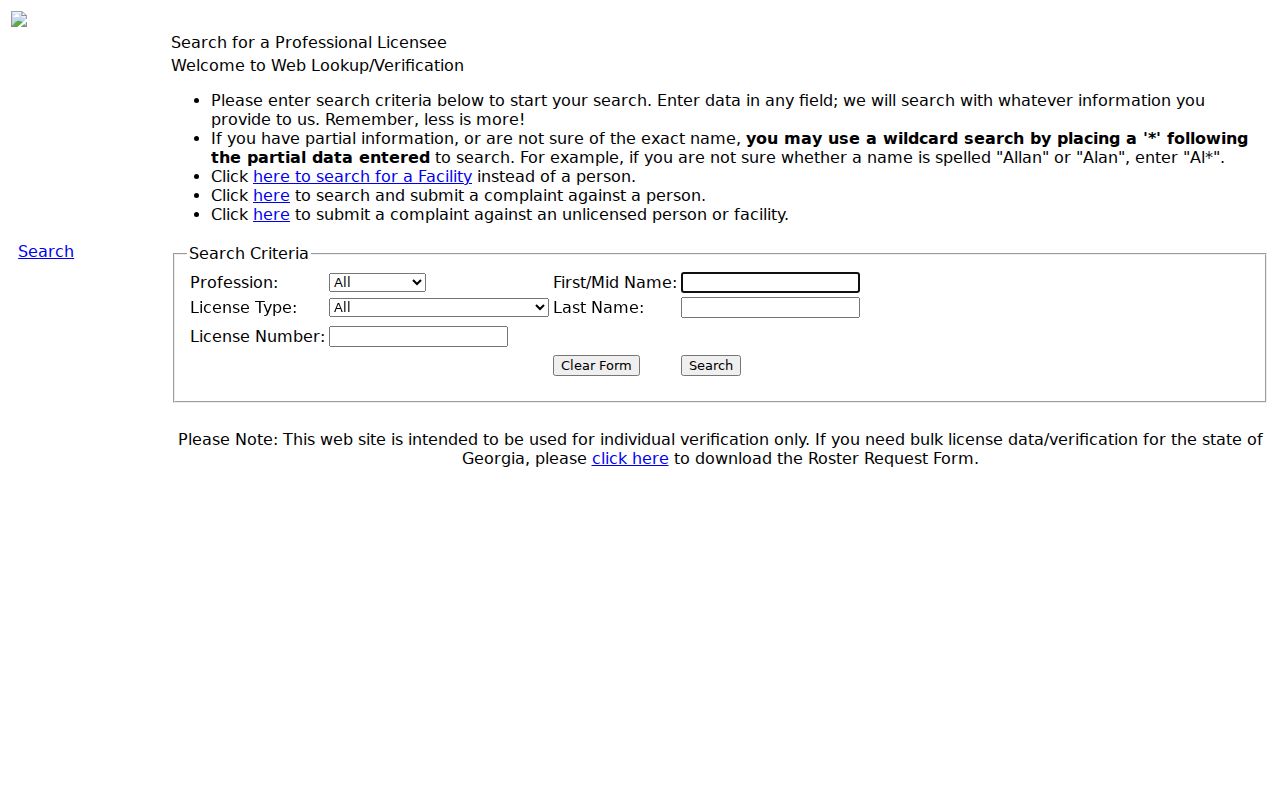
Public board records give stronger support than an unverified compilation.
Official Albany Records Versus Compilations
Official records answer narrow questions and identify the office responsible for corrections. Commercial people-finder compilations blend public and commercial data. They can be stale, misattributed, or detached from the source. Use them only as leads and never as identity proof.
| Source | Strength | Limit |
|---|---|---|
| Albany or Dougherty record | Known custodian and purpose | Often covers one role or date |
| Georgia registry | Official business, license, or corrections data | Fields and limits vary |
| Commercial compilation | Broad lead gathering | May be stale or mislinked |
Use Albany records only for lawful personal research. Never use names, addresses, or filings to stalk, harass, threaten, or harm anyone.
Older Albany Trails Change Counties
Dougherty County was created from Baker County in 1853, and territory from Worth County was added in 1854 and 1856. Albany became the county seat. The oldest verified Dougherty deed books begin in 1854, with indexes from 1856. A trail from before county formation may therefore move to Baker records, while some border questions may require Worth sources.
Albany itself was founded on the Flint River in 1836. Rail service arrived in 1857, and later migration brought railroad, military, and industrial workers. Those shifts can move a family between city directories, county land records, and papers published under different Albany titles. Historic record geography also extends beyond the central street grid, so a failure under one city heading does not prove the person left Dougherty County.
Do not turn flood history into a courthouse-loss claim. Flint River floods in 1841, 1925, and 1994 shaped movement and address history, but no proof was found that they destroyed courthouse records. The current courthouse is the county's third and dates to 1968. Boundary dates, directories, and deed books better explain a missing Albany result.
Request Albany Records Not Online
Georgia's Open Records Act, O.C.G.A. §§50-18-70 through 50-18-77, is the fallback when records lack a name index. Identify the custodian and ask for an existing record. Give a name, date range, and any case, book, parcel, permit, or report number. An agency generally must respond within three business days with the record, an exemption citation, or a time and cost estimate.
Albany city requests use JustFOIA. County court and land requests go to the Clerk, while estate files go to Probate Court. Retain the confirmation and narrow a broad request if the estimate is high. Ask for a certified copy only when an official seal is needed.
The Georgia Attorney General open-government FAQ explains the response framework.
The request process helps when a permit, city case, or older file has no public search screen.